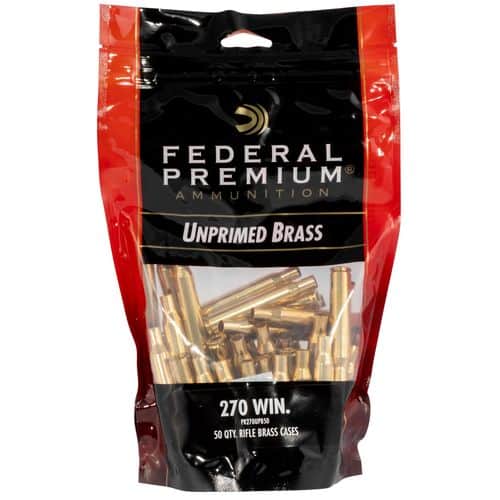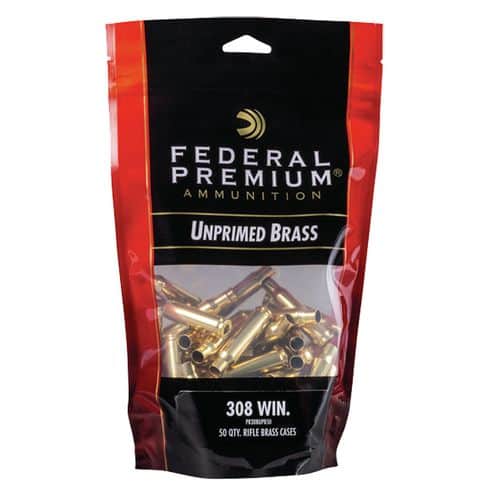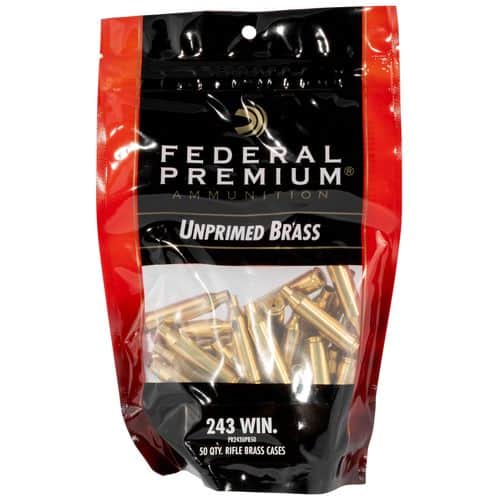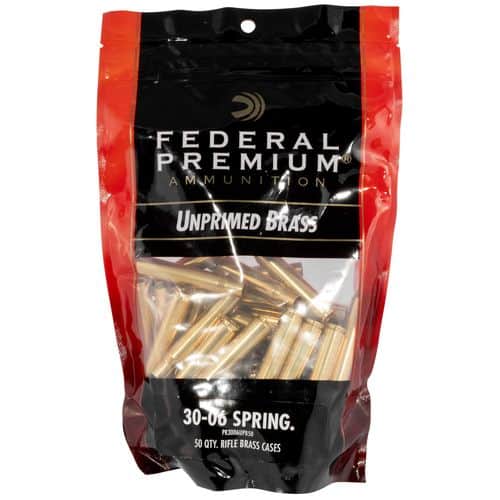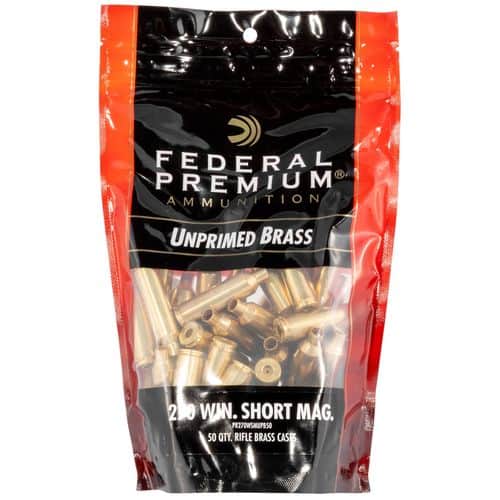






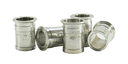















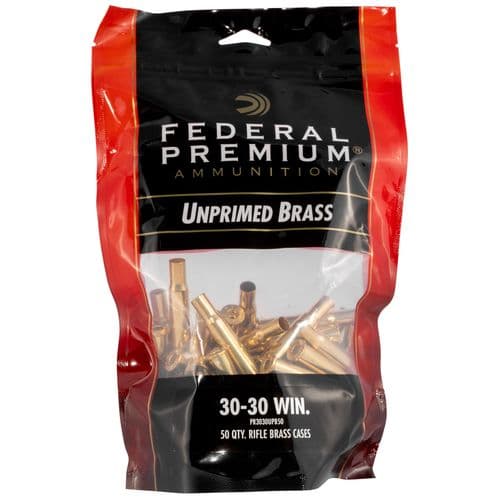

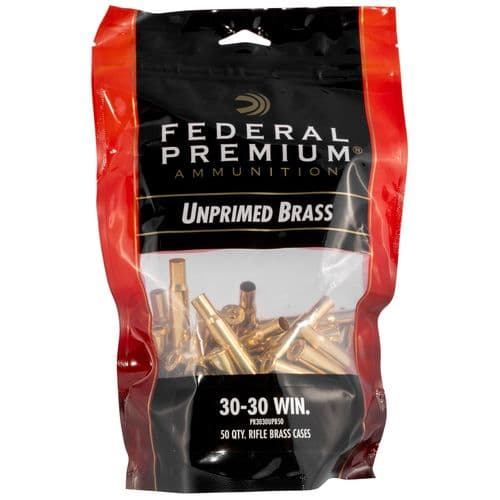
Federal PR3030UPB50 Gold Medal Rifle 30-30 Winchester Brass 50
$0.00
Please Allow 4-5 Business Days for In Store Pickup

Federal Gold Medal 30-30 Winchester Unprimed Brass: The Foundation for Precision Handloads
Are you an avid hunter, a dedicated target shooter, or a firearms enthusiast who demands ultimate control over your ammunition's performance? Do you seek to optimize accuracy, achieve greater consistency, or simply enjoy the rewarding process of crafting your own cartridges? For anyone looking to unlock the full potential of their 30-30 Winchester rifle, the choice of components is paramount, and it all starts with premium brass. Federal Gold Medal 30-30 Winchester Unprimed Brass, available in convenient 50-count packs, provides the critical foundation for producing high-quality, reliable, and exceptionally accurate handloads.
This isn't just any brass; it's a meticulously manufactured component designed to meet the rigorous standards of competitive shooters and discerning reloaders. When users ask questions like "What is the best brass for reloading 30-30 Winchester?" or "How can I improve the consistency of my lever-action rifle's ammunition?", the answer often points directly to high-quality unprimed cases like these.
Why Choose Federal Gold Medal 30-30 Winchester Unprimed Brass?
The reputation of Federal's Gold Medal line is built on a legacy of precision and reliability. When it comes to unprimed brass, this means a commitment to uniformity, concentricity, and durability—qualities that are absolutely essential for achieving repeatable accuracy and maximizing case life through multiple reloading cycles.
- Exceptional Consistency: One of the primary benefits of Federal Gold Medal brass is its unparalleled consistency in weight, wall thickness, and internal capacity. This uniformity ensures that each cartridge you load will have similar internal ballistics, leading to tighter groups on target and predictable performance in the field. Slight variations in brass dimensions can lead to significant variations in pressure, velocity, and point of impact. Federal's stringent quality control minimizes these variances, giving reloaders a distinct advantage.
- Optimal Case Life: Engineered for resilience, Federal Gold Medal brass is designed to withstand the stresses of firing and repeated resizing. This translates to more reloads per case, offering significant long-term value and reducing the frequency of having to purchase new brass. For serious reloaders, maximizing case life is not just about cost savings; it's about maintaining a consistent supply of brass that has "fire-formed" to their specific rifle's chamber, often leading to even better accuracy.
- Superior Annealing: Proper annealing is crucial for the neck durability and overall case integrity. Federal's annealing process ensures the brass is ductile enough to withstand sizing and bullet seating without cracking, yet strong enough to maintain neck tension shot after shot. This balance is key to both safety and performance.
- Precise Dimensional Tolerances: From the consistent flash hole diameter to the uniform primer pocket, every aspect of Federal Gold Medal brass is held to tight tolerances. This precision ensures proper primer seating, consistent ignition, and smooth feeding and extraction from your firearm. When every component fits together perfectly, the entire reloading process becomes more efficient and the resulting ammunition more reliable.
- Trusted by Experts: Federal's Gold Medal products are often the choice of competitive shooters and expert handloaders who understand that the quality of their components directly impacts their performance. This unprimed brass carries that same pedigree, offering a professional-grade starting point for your custom loads.
Understanding the 30-30 Winchester Cartridge
To truly appreciate the value of premium 30-30 Winchester unprimed brass, it's helpful to understand the cartridge itself. The 30-30 Winchester, introduced by Winchester in 1895 for their Model 1894 lever-action rifle, is one of the most iconic and enduring rifle cartridges in North American history. It quickly became, and remains, a quintessential deer hunting round, particularly in dense brush or timber where shots are typically taken at moderate ranges.
- Historical Significance: The 30-30 Winchester was one of the first small-bore smokeless powder sporting cartridges, marking a significant leap forward from black powder designs. Its introduction revolutionized hunting, offering flatter trajectories and higher velocities than its predecessors.
- Popular Firearms: While primarily associated with lever-action rifles like the Winchester Model 1894 and Marlin Model 336, the 30-30 Winchester has also been chambered in single-shot rifles and, less commonly, bolt-action firearms. Its rimmed design makes it ideal for tubular magazines, which are common in lever-action rifles.
- Versatile Performance: Typically loaded with bullets ranging from 150 to 170 grains, the 30-30 Winchester is highly effective for medium-sized game like whitetail deer, black bear, and wild hogs. Its moderate recoil and sufficient energy for ethical kills within 200 yards make it a perennial favorite among hunters.
- Why Reload the 30-30? Reloading this classic cartridge offers numerous advantages. It allows hunters to fine-tune loads for specific bullet types (e.g., traditional flat-nose soft points, FTX-style polymer-tipped bullets for better ballistics in tubular magazines, or specialized cast bullets) and to optimize velocity and accuracy for their specific rifle. For target shooters, handloading the 30-30 can transform a utilitarian hunting rifle into a surprisingly accurate range companion. It also often provides substantial cost savings compared to purchasing factory ammunition, especially given the continuous demand for popular hunting calibers.
The Art and Science of Handloading Ammunition
Handloading is a precise and rewarding hobby that empowers shooters to create ammunition tailored to their specific needs and firearms. It's a blend of science, attention to detail, and a deep understanding of ballistics. The journey from unprimed brass to a finished cartridge involves several critical steps, each of which benefits immensely from the use of high-quality components like Federal Gold Medal brass.
Key Steps in Reloading Your Own 30-30 Winchester Ammunition:
- Case Inspection and Cleaning: Even new unprimed brass should be inspected for any minor dents or imperfections. While new brass is typically clean, fired brass requires thorough cleaning to remove carbon fouling and other residues.
- Case Lubrication (for sizing): A thin layer of case lube is essential before sizing to prevent the brass from sticking in the die.
- Resizing: This step restores the fired case to its proper dimensions so it can chamber correctly and hold a new bullet.
- Full-Length Sizing: Resizes the entire case body and neck back to factory specifications. This is often necessary for ammunition that will be used in multiple rifles or for semi-automatic firearms.
- Neck Sizing: Only resizes the neck of the case, leaving the body fire-formed to your rifle's chamber. This can sometimes improve accuracy by ensuring a perfect fit, but it means the ammunition will only reliably chamber in the rifle it was fired from.
- Decapping (if applicable, for fired brass): Removes the spent primer. Unprimed brass like Federal PR3030UPB50 does not require this step as it arrives without a primer.
- Primer Pocket Swaging/Uniforming (if needed): Some military brass may have crimped primer pockets that need to be removed. New brass typically has uniform primer pockets ready for priming.
- Case Trimming: Brass stretches with each firing. Cases must be trimmed to a uniform length to ensure consistent neck tension and to prevent issues like crimping into the bullet's ogive or excessive case length that could interfere with chambering or create dangerous pressures.
- Chamfering and Deburring: After trimming, the case mouth is chamfered (beveled inside) and deburred (smoothed outside) to facilitate smooth bullet seating and prevent damage to the bullet or case.
- Priming: A new primer is seated into the primer pocket. This is a critical step, as inconsistent primer seating can lead to unreliable ignition. Federal Gold Medal brass features precisely manufactured primer pockets to ensure consistent seating.
- Powder Charging: The correct type and charge weight of smokeless powder are dispensed into the case. Precision is paramount here, as too much or too little powder can be dangerous or lead to poor performance.
- Bullet Seating: The bullet is seated to the correct overall length (OAL) for the specific firearm and cartridge. Consistent OAL is crucial for accuracy and safe operation.
- Crimping (Optional but Recommended for 30-30): For cartridges used in tubular magazines (like most 30-30s), a crimp is often applied to secure the bullet firmly in place against recoil and prevent bullet setback during cycling. A proper crimp is essential for consistent ignition and safe feeding in lever-action rifles.
Maximizing Performance with Premium Brass
The quality of your unprimed brass, such as Federal Gold Medal, directly influences several key aspects of your handloads' performance:
- Accuracy: Consistent case dimensions and uniform wall thickness contribute to lower Standard Deviation (SD) and Extreme Spread (ES) in velocity, which directly translates to tighter groups on paper. When the brass is uniform, the pressure curve and bullet launch are more consistent.
- Velocity Consistency: High-quality brass ensures consistent internal volume, meaning that a given powder charge will produce more uniform pressures and velocities from shot to shot. This is vital for consistent bullet drop and accurate long-range (or even moderate-range for 30-30) shooting.
- Reliability: Properly manufactured brass ensures smooth feeding, extraction, and consistent primer ignition, reducing the chances of malfunctions in the field or at the range.
- Safety: While not often discussed, uniform brass ensures that internal pressures are consistent and within safe limits, provided appropriate loading data is followed. Inferior brass with inconsistent wall thicknesses or weak spots could potentially lead to dangerous pressure spikes or case failures.
Key Considerations for Reloading 30-30 Winchester
When reloading the 30-30 Winchester, especially for lever-action rifles, certain considerations are important:
- Bullet Type: Due to tubular magazines, bullets with flat noses or soft, polymer tips (like Hornady's LEVERevolution FTX bullets) are generally recommended to prevent accidental primer ignition of the cartridge in front during recoil. Round nose or spire point bullets can be used in single-shot 30-30s.
- Crimping: A good roll crimp or taper crimp is essential to prevent bullet setback in tubular magazines and ensure reliable feeding.
- Powder Selection: Medium-burning rifle powders are typically ideal for the 30-30 Winchester, balancing velocity with appropriate pressure. Always consult multiple, reliable reloading manuals for specific powder charges and bullet combinations.
- Primer Type: The 30-30 Winchester typically uses Large Rifle primers. Federal Gold Medal brass is designed to accept standard Large Rifle primers.
Benefits of Reloading Your Own 30-30 Ammunition
- Cost Savings: Over time, reloading can significantly reduce the cost per round, especially for high-volume shooters. While the initial investment in equipment can be substantial, the savings on components quickly add up.
- Customization: Tailor your ammunition precisely to your rifle's preferences and your specific shooting needs. Experiment with different bullet weights, powder types, and charge weights to find the "perfect" load for accuracy, velocity, or terminal performance.
- Improved Accuracy: Handloads often outperform factory ammunition in terms of precision, as they can be fine-tuned to your rifle's unique characteristics.
- Educational Value: Reloading provides a deeper understanding of internal and external ballistics, firearm mechanics, and cartridge design.
- Self-Sufficiency: In times of ammunition shortages, being able to produce your own rounds provides peace of mind and ensures you can continue to enjoy your shooting activities.
Where to Find Your Reloading Essentials
For reloaders seeking to maximize their ammunition's potential, investing in high-quality components is non-negotiable. Federal Gold Medal 30-30 Winchester Unprimed Brass (Product Code: PR3030UPB50) provides the ideal starting point for crafting superior 30-30 Winchester ammunition. You can find this premium unprimed brass, along with a comprehensive selection of other reloading supplies, bullets, primers, powders, and firearms, conveniently available at DEGuns.com. DEGuns offers a reliable source for all your shooting and reloading needs, ensuring you have access to the components that will help you achieve peak performance whether you're at the range or in the field.
Product Specifications
| Feature | Detail | Benefit |
|---|---|---|
| Caliber | 30-30 Winchester | Classic, versatile rifle cartridge. |
| Type | Unprimed Brass | Essential component for handloading. |
| Count | 50 Pieces | Convenient quantity for reloaders. |
| Brand | Federal Gold Medal | Renowned for precision and consistency. |
| Primer Pocket | Large Rifle | Standard for 30-30 Winchester primers. |
| Product Code | PR3030UPB50 | Unique identifier for this specific product. |
| Availability | Exclusively at DEGuns.com | Reliable source for quality components. |
Specifications
Explore the specific details and characteristics
- SKU
- PR3030UPB50