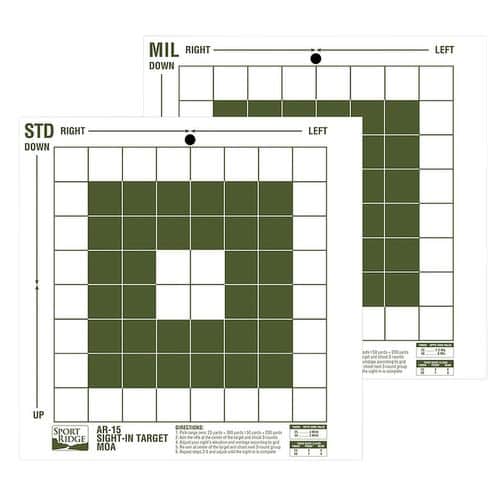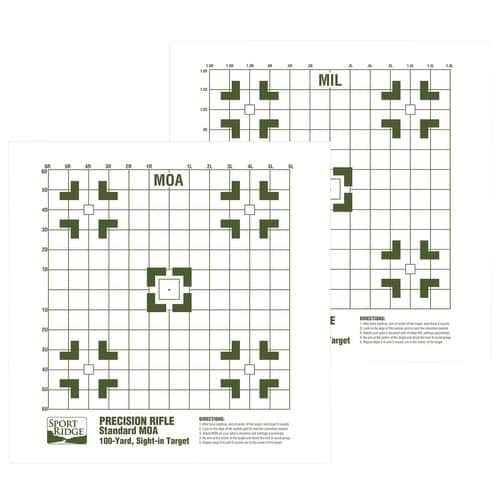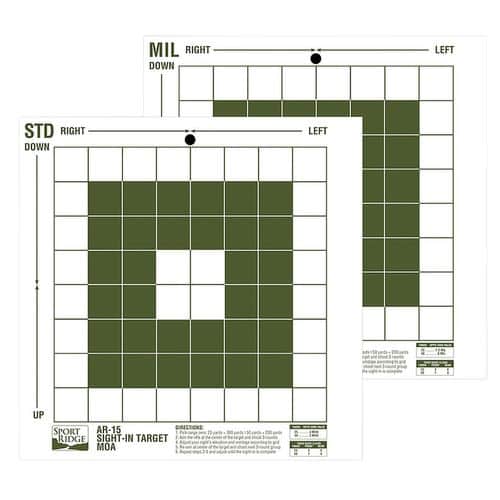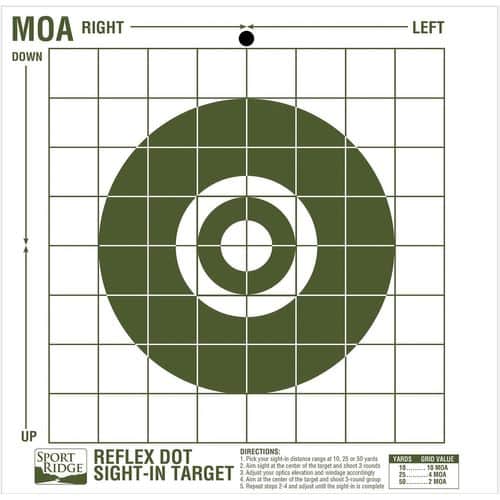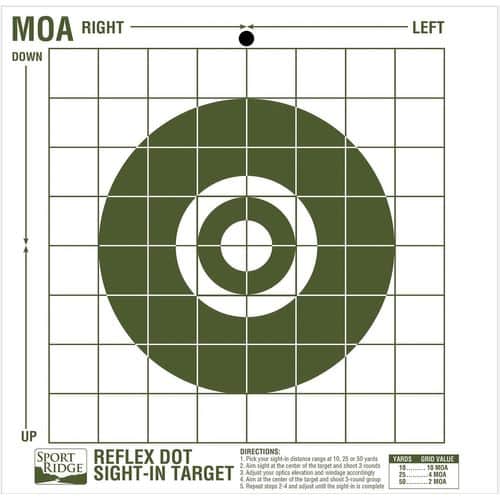






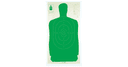




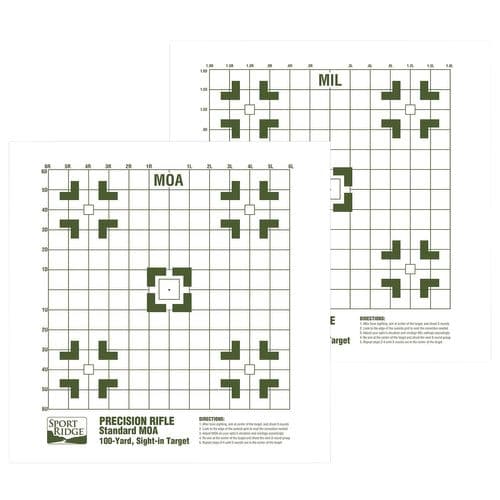

Sport Ridge 03730 Sport Ridge Sight-in Targets MOA and Mil-Dot Premium Durable Paper Target 16" x 16" 8 Per Pkg
$0.00
Please Allow 4-5 Business Days for In Store Pickup

Achieving Unwavering Accuracy: The Definitive Guide to Sport Ridge MOA and Mil-Dot Sight-in Targets
For every responsible firearm owner, enthusiast, hunter, or competitive shooter, the pursuit of precision is a continuous journey. At the heart of this endeavor lies a fundamental truth: you cannot consistently hit what you cannot accurately aim for. This is where high-quality sight-in targets become an indispensable asset. Among the myriad options available, the Sport Ridge 03730 Sport Ridge Sight-in Targets MOA and Mil-Dot Premium Durable Paper Target 16" x 16" 8 Per Pkg stands out as a critical tool designed to elevate your shooting prowess, streamline your zeroing process, and foster a deeper understanding of ballistic performance.
So, who is this product for? These targets are meticulously crafted for anyone who owns a scoped rifle or pistol and seeks to establish or maintain a precise zero. Whether you're a novice looking for the best tools to learn how to sight in a new optic, a seasoned hunter preparing for an ethical harvest, a competitive shooter striving for tighter groups, or a casual range-goer dedicated to improving personal bests, these targets provide the structured feedback necessary for meaningful progress. They solve the pervasive problem of inaccurate shot placement, wasted ammunition, and the frustration that comes with an improperly sighted firearm. With the Sport Ridge 03730 targets, you gain the clarity and consistency required to confidently make precise adjustments to your scope or red dot sight.
What are Sight-in Targets and Why Are They Essential for Every Shooter?
At its core, a sight-in target is a specialized paper or material designed with precise grids and aiming points that facilitate the process of aligning a firearm's sights or optic with the actual point of impact (POI) of the bullet. Unlike generic bullseye targets that primarily serve for general practice, dedicated sight-in targets like the Sport Ridge 03730 incorporate measurement units, most commonly MOA (Minute of Angle) and Mil-Dot (Milliradian), directly onto the target face. This integration is crucial because it allows shooters to directly translate the bullet's deviation from the point of aim (POA) into the exact number of clicks or adjustments needed on their scope's turrets.
The necessity of these targets cannot be overstated. An improperly zeroed firearm is not only inefficient, leading to missed shots and frustrated range sessions, but it can also be a safety concern, particularly in hunting scenarios where an ethical shot is paramount. Using the right target transforms the often-daunting task of zeroing into a systematic, repeatable process. They provide instantaneous, quantifiable feedback, allowing you to fine-tune your optic with precision and confidence. Without such a tool, adjusting your scope becomes a trial-and-error guessing game, consuming excessive time and ammunition.
Understanding MOA (Minute of Angle) for Precision Scope Adjustments
For many shooters, MOA is the primary unit of angular measurement used in scope adjustments and ballistic calculations. But what exactly is a Minute of Angle, and how does it relate to hitting your target?
A Minute of Angle is an angular unit of measure. Imagine a circle divided into 360 degrees, and each degree further divided into 60 minutes. One minute of angle (1 MOA) subtends approximately 1.047 inches at 100 yards. For practical purposes, most shooters round this down to 1 inch at 100 yards, making calculations simpler and generally accurate enough for hunting and most recreational shooting. This relationship scales linearly:
- At 200 yards, 1 MOA is approximately 2 inches.
- At 300 yards, 1 MOA is approximately 3 inches.
- And so on.
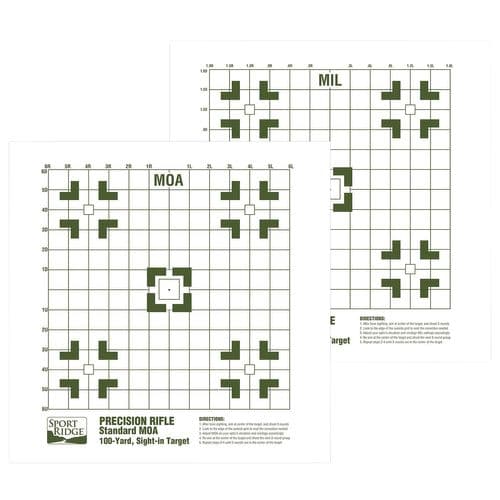
The Sport Ridge 03730 targets feature clear MOA grids, which are invaluable for shooters whose scopes utilize MOA-based turrets. When you fire a group of shots at, say, 100 yards, and your point of impact is 3 inches low and 2 inches left of your point of aim, the MOA grid on the target immediately tells you that you need to adjust your scope 3 MOA up and 2 MOA right. If your scope turrets adjust in ¼ MOA increments, then you'd need 12 clicks up (3 MOA x 4 clicks/MOA) and 8 clicks right (2 MOA x 4 clicks/MOA).
Common questions related to MOA targets include:
- "How do I zero my rifle using MOA?"
- "What targets are best for zeroing an MOA scope?"
- "How many clicks is 1 MOA on my scope?"
- "How to calculate MOA adjustments for different distances?"
These targets provide the visual framework to answer these questions directly, allowing for efficient and accurate scope adjustments based on your shot groups. They are particularly beneficial for shooters using scopes with MOA reticles, as they allow for direct comparison between the target grid and the reticle.
Mastering Mil-Dot (Milliradian) for Advanced Ranging and Holdovers
While MOA is prevalent, many modern tactical and long-range shooting optics utilize the Milliradian (Mil or MRAD) system. Mil-Dot reticles and Mil-based turrets are common in precision shooting disciplines due to their often finer adjustments and a consistent decimal system, making calculations straightforward for those familiar with it.
A Milliradian is another angular unit of measure. One Mil is approximately 3.6 inches at 100 yards. Similar to MOA, this scales with distance:
- At 200 yards, 1 Mil is approximately 7.2 inches.
- At 300 yards, 1 Mil is approximately 10.8 inches.
- And so on.
The Sport Ridge 03730 targets are dual-purpose, also featuring a precise Mil-Dot grid. This allows shooters with Mil-based optics to apply the same direct translation principles as with MOA. If your shots are consistently 0.5 Mils low and 0.3 Mils left at 100 yards, you simply adjust your scope 0.5 Mils up and 0.3 Mils right. If your scope adjusts in 0.1 Mil increments, you would need 5 clicks up and 3 clicks right.
Mil-Dot targets are not only essential for zeroing Mil-based scopes but also for practicing range estimation techniques using a Mil-Dot reticle. By knowing the size of a known object (e.g., a standard-sized deer or a target of known dimensions) and observing how many Mils it subtends through your scope, you can estimate its distance. This skill, along with practicing holdovers (adjusting your aim point without touching the turrets) and windage calls, is greatly enhanced by using targets that accurately represent Mil subtensions.
Common questions often answered with Mil-Dot targets include:
- "What is a Mil-Dot reticle used for?"
- "How do I use Mil-Dot for range estimation?"
- "What's the difference between MOA and Mil-Dot?"
- "How to zero a Mil-based scope?"
The dual MOA and Mil-Dot design of the Sport Ridge 03730 targets makes them incredibly versatile, catering to a wide array of shooters and optic preferences, and serving as a fantastic learning tool for understanding both systems.
Sport Ridge 03730 Targets: Design, Durability, and Practical Benefits
The specific design of the Sport Ridge 03730 targets is optimized for practical use and provides significant advantages to the shooter:
- Generous 16" x 16" Dimensions: This size provides ample space for shooting groups, even at longer distances where precision is more challenging. The large format ensures that even if your initial shots are significantly off-target, they are still likely to land on the paper, allowing for immediate feedback and adjustments. It's large enough to capture an entire group of shots while still providing sufficient border for mounting.
- Premium Durable Paper: Unlike flimsy targets that tear easily or absorb moisture, the premium paper used in Sport Ridge targets is designed to withstand multiple impacts and remain intact throughout your shooting session. This durability means less time spent walking downrange to replace targets and more time focused on shooting and making adjustments. It provides clean bullet holes, making it easier to identify your point of impact and measure your groups accurately.
- Clear, High-Contrast MOA and Mil-Dot Grids: The markings are sharp and highly visible, even from a distance, which is critical for precise measurement. The high contrast ensures that your bullet holes are easily distinguishable against the grid, preventing eye strain and allowing for quick, accurate assessment of your shot placement relative to the aiming point and the grid lines.
- 8 Targets Per Package: The generous quantity ensures you have enough targets for multiple zeroing sessions, load development, or extensive practice. This value pack allows shooters to perform initial zeroing, confirm zero after travel, practice cold bore shots, and fine-tune various ammunition types without constantly restocking. It's a cost-effective solution for consistent range activity.
These features combined contribute to an exceptional user experience, allowing shooters to concentrate on fundamental marksmanship skills and the systematic process of zeroing rather than struggling with inadequate equipment.
The Zeroing Process: A Step-by-Step Guide for Optimal Accuracy
Using the Sport Ridge 03730 targets, the process of zeroing your firearm's optic becomes straightforward and highly effective. Here’s a basic guide:
- Preparation is Key:
- Secure Platform: Use a sturdy shooting bench, sandbags, a bipod, or a shooting rest to eliminate human error from the equation. Consistency in your shooting position is paramount.
- Ammunition: Use the same type of ammunition you intend to use for hunting or competition. Different bullet weights and types will impact the point of aim/point of impact.
- Bore Sighting (Optional but Recommended): For initial setup, consider bore sighting your rifle. This can be done with a laser bore sighter or by visually aligning the bore with the target. While not a true zero, it gets you on paper quickly, saving valuable ammunition.
- Initial Shots and Grouping:
- Set up your Sport Ridge target at your chosen zeroing distance (e.g., 50 yards for an initial rough zero, then 100 or 200 yards for final zero).
- Fire a controlled group of 3-5 shots, aiming consistently at the bullseye. Focus on proper breathing, trigger control, and follow-through.
- Calculate Adjustments Using the Target Grid:
- Once your group is complete, carefully observe its location relative to your point of aim.
- Using the MOA or Mil-Dot grid lines on the Sport Ridge target, measure the exact vertical and horizontal displacement of the center of your shot group from the bullseye. For example, if your group is 2 MOA low and 1 MOA left.
- Make Scope Adjustments:
- Consult your scope's instruction manual to determine its click value (e.g., ¼ MOA per click, 0.1 Mil per click).
- Based on your measurements from the target, adjust your scope's elevation (up/down) and windage (left/right) turrets.
- Remember: "UP" on the turret moves the point of impact UP, and "RIGHT" on the turret moves the point of impact RIGHT. If your shots are low, adjust UP. If they are left, adjust RIGHT.
- Confirm Your Zero:
- Fire another 3-5 shot group, again aiming at the bullseye. This group should now be much closer to your point of aim, ideally centered.
- If necessary, repeat steps 3-5 for fine-tuning until your groups are consistently hitting the bullseye at your desired zeroing distance.
- Considerations for Advanced Zeroing:
- Cold Bore Shot: Practice firing a single "cold bore" shot after the rifle has cooled completely. This often impacts differently than subsequent shots.
- Environmental Factors: Wind, temperature, and humidity can all affect bullet trajectory. While zeroing is typically done in calm conditions, be aware of these variables for real-world scenarios.
- Multiple Distances: Once zeroed at a primary distance (e.g., 100 yards), practice at other relevant distances (e.g., 200, 300 yards) to understand your rifle's ballistic curve and confirm holdovers.
Beyond Zeroing: How These Targets Enhance Marksmanship Skills
The utility of Sport Ridge MOA and Mil-Dot targets extends far beyond the initial zeroing process. They are powerful tools for continuous skill development:
- Grouping Practice: Regularly shooting groups helps you identify and correct fundamental shooting errors like flinching, jerking the trigger, or inconsistent cheek weld. The precise grids allow for objective measurement of group size and consistency over time.
- Load Development: For reloaders, these targets are invaluable for testing different powder charges, bullet types, and seating depths to find the most accurate load for a specific rifle. The clear feedback helps discern subtle differences in accuracy.
- Recoil Management: Consistent practice with these targets helps develop proper recoil management techniques, allowing for faster follow-up shots and maintaining accuracy.
- Breathing and Trigger Discipline: The focus required to achieve tight groups on the precise grid encourages meticulous attention to breathing control and smooth, consistent trigger pulls.
- Holdover and Windage Drills: For long-range shooters, these targets are excellent for practicing holdovers (aiming above or to the side of the target to compensate for bullet drop or wind) without adjusting scope turrets. You can intentionally aim at specific grid intersections to simulate real-world scenarios.
- Familiarization with Reticles: For new users of MOA or Mil-Dot reticles, these targets provide a tangible reference point to understand how the reticle's subtensions relate to actual measurements on paper.
Why Quality Targets Matter for Consistent Performance
Choosing a high-quality target like the Sport Ridge 03730 is not merely a preference; it’s an investment in your shooting accuracy and efficiency.
- Clarity of Markings: Faint or blurry lines lead to measurement errors and frustration. The crisp, clear lines on Sport Ridge targets ensure accurate readings.
- Clean Bullet Holes: Poor quality paper can tear or create ambiguous holes, making it hard to determine the exact point of impact. Premium paper provides distinct, measurable holes.
- Durability and Longevity: Constantly changing targets interrupts your shooting rhythm and wastes range time. A durable target allows for extended practice sessions with fewer interruptions.
- Reliable Feedback: Ultimately, the target is your primary source of feedback. A well-designed target provides reliable and immediate data, enabling informed decisions for scope adjustments and skill improvement.
The Sport Ridge 03730 Sport Ridge Sight-in Targets MOA and Mil-Dot Premium Durable Paper Target 16" x 16" 8 Per Pkg are not just paper; they are a fundamental component of effective marksmanship training. They empower shooters to understand their equipment better, refine their techniques, and achieve the consistent accuracy that defines true proficiency. This product, manufactured by Sport Ridge, is a highly recommended tool for any shooter serious about improving their performance.
These essential targets, bearing the UPC 6880003730, are readily available at DEGuns.com, ensuring easy access for all your shooting needs. Investing in these targets is investing in your precision, confidence, and overall shooting enjoyment.
Product Specifications and Features
| Feature | Description |
|---|---|
| Product Name | Sport Ridge Sight-in Targets |
| Model Number | 03730 |
| UPC | 6880003730 |
| Target Type | MOA and Mil-Dot Grid System |
| Material | Premium Durable Paper |
| Dimensions | 16 inches x 16 inches (40.64 cm x 40.64 cm) |
| Quantity Per Pack | 8 Targets |
| Primary Use | Firearm Zeroing, Scope Calibration, Marksmanship Training, Load Development |
| Compatibility | Rifles, Pistols, Airguns (with scopes/optics) |
MOA vs. Mil-Dot: A Quick Comparison
| Characteristic | Minute of Angle (MOA) | Milliradian (Mil/MRAD) |
|---|---|---|
| Angular Value | ~1.047 inches at 100 yards | ~3.6 inches at 100 yards |
| Common Increment | 1/4 MOA per click (0.25 inches @ 100yds) | 0.1 Mil per click (0.36 inches @ 100yds) |
| Primary Use | Common in hunting and sport shooting optics | Common in tactical and long-range precision optics |
| Calculation Style | Often involves fractions/decimals, less direct ratio | Decimal-based, often simpler for quick calculations |
Specifications
Explore the specific details and characteristics
- SKU
- 3730